The US Product Manager job market in 2026 shows signs of recovery, but hiring remains selective. Broader technology hiring data points to a recovery: Lenny Rachitsky’s early-2026 “State of the Product Job Market” report, based on TrueUp data covering more than 9,000 tech companies globally, found over 7,300 open PM roles — the highest level in more than three years, and roughly 75% above the early-2023 low. Because this dataset is global rather than US-specific, treat it as a broader PM-hiring signal rather than a precise US count.
The recovery is not a return to the 2021–2022 hiring boom. The current market is better described as a selective recovery: openings have increased, but employers are scrutinizing specialization, technical fluency, and demonstrated impact more closely than during the peak.
The practical read: hiring is real but selective. The market increasingly shows strong demand for specialized PM capabilities — particularly AI-adjacent, technical, platform, and growth/monetization expertise — alongside continued demand for generalist PMs. IdeaPlan’s 2026 “State of Product Management” report found 61% of PM job postings mention AI, while 23% of senior-level postings specifically require experience shipping AI-powered products — an important distinction, since “mentions AI” and “requires AI experience” aren’t the same bar.
What this means for your job search: a broad “Product Manager” profile can be hard to differentiate in a crowded field. Candidates who clearly signal TPM depth, AI/ML fluency, platform ownership, or a specific vertical (fintech, healthtech, marketplaces) often give employers a clearer reason to shortlist them.
Methodology note: job-market statistics in this guide come from the cited sources below and may use different definitions of “job posting,” “PM role,” and geographic coverage. Compensation figures are reported total compensation unless stated otherwise. Treat all figures as directional, not exact.
The “PM” umbrella covers meaningfully different jobs. Here’s what each title typically means in a US company:
| Title | What it actually means |
|---|---|
| Associate PM (APM) | Entry-level, often via a structured early-career or rotational program. Execution-heavy: specs, analytics, coordinating with design/eng. Typically 0–2 years of experience, though requirements vary by employer. |
| Product Manager | The core IC role. Owns a feature area or small product surface end-to-end: discovery, roadmap, launch, metrics. |
| Senior Product Manager | Owns a larger, more ambiguous problem space. Expected to set strategy for their area, not just execute a roadmap handed to them. |
| Staff Product Manager | Senior individual-contributor role, usually above Senior PM and below or parallel to Principal PM depending on the company. Owns complex, high-impact problems spanning multiple teams. |
| Group Product Manager (GPM) | Often a people-management role at companies that use this title that way — managing a small team of PMs across a product line, still hands-on with strategy. Other companies use it for a senior influence-based IC track instead. Organizational structure varies significantly by employer. |
| Principal PM | Senior individual-contributor level whose organizational equivalent varies by company — at some firms below Director, at others representing an extremely senior IC scope. Deep expertise, often the go-to for the hardest cross-org problems. |
| Product Owner | Often responsible for backlog prioritization, requirements, and delivery for a specific team. Scope varies widely by company — some Product Owner roles are functionally equivalent to PM, others are far more execution-focused. |
| Growth / Monetization PM | Focuses on acquisition, activation, retention, pricing, conversion, and revenue-related outcomes rather than general feature ownership. |
| Director of Product | Typically manages multiple PM teams and/or GPMs and owns a full product area’s outcomes. Exact scope, reporting line, and whether the role is pure people-management or hybrid IC/management varies by company — commonly reports to a VP of Product or CPO where those titles exist. |
| Technical Program Manager (TPM) | Owns complex cross-team technical programs, dependencies, execution, and delivery. Depending on the company, TPMs may also influence technical strategy and architecture. Distinct from product PM by scope, but responsibilities vary by employer. Placeman treats TPM as PM-adjacent, not identical. |
| AI Product Manager | Owns AI/ML-powered features, platforms, evaluation, and data-quality/feedback loops — requires fluency in model capabilities/limitations and responsible-AI tradeoffs, not just standard PM skills. |
| Data Product Manager | Owns internal or external data platforms/pipelines as the “product” — common at companies where data infrastructure itself is monetized or is core to other teams’ work. |
| Platform PM | Owns internal or developer-facing platforms (APIs, infrastructure, internal tools) rather than a consumer-facing surface. |
PM-adjacent roles you’ll also see on job boards: Product Marketing Manager, Product Operations Manager, Product Analyst, and Product Designer are commonly confused with PM roles but are distinct disciplines — Placeman focuses on PM/TPM-track roles specifically. Titles and leveling are not standardized industry-wide: a “Principal PM” at one company may have scope similar to a Staff PM or Director-level IC elsewhere. Always read the job description’s actual responsibilities, not just the title.
Compensation data varies significantly depending on whether a source reports base salary or total compensation (TC) — base + bonus + equity — and whether a figure represents one specific level or is aggregated across all levels at a company. This section is explicit about both.
According to Levels.fyi, median US Product Manager total compensation across all reported levels is approximately $230,000 (25th percentile ~$168K, 75th percentile ~$330K, as of mid-2026).
Illustrative US PM compensation ranges, by level (directional estimates compiled from multiple datasets — not standardized national salary bands; actual pay varies by company, location, level, industry, and equity structure):
| Level | Illustrative Base Salary | Illustrative Total Compensation |
|---|---|---|
| Entry Level / APM | $98,000 – $168,000 | $135,000 – $190,000 |
| Product Manager | $130,000 – $195,000 | $165,000 – $290,000 |
| Senior Product Manager | $175,000 – $250,000 | $250,000 – $400,000+ |
| Staff / Principal PM | $210,000 – $280,000 | $370,000 – $500,000+ |
| Group Product Manager (GPM) | $195,000 – $260,000 | $320,000 – $450,000+ |
| Director of Product | $250,000 – $390,000 | $400,000+ |
Selected Product Manager total compensation by company (Levels.fyi, 2026):
Levels.fyi figures are company-wide PM compensation medians across reported levels and should not be interpreted as the expected compensation for a typical mid-level PM. Figures can vary by location, level, sample, and database update timing — treat each as an approximate snapshot, not a precise statistical range.
| Company | Reported US PM Median TC† |
|---|---|
| ~$535,000–$575,000 | |
| Meta | ~$486,000 |
| Microsoft | ~$270,000–$283,000 |
| Indeed | ~$281,000 |
| Glassdoor (as employer) | ~$205,000–$314,000 |
†Directly checked against live Levels.fyi pages and structured data exports, August 2026. Levels.fyi medians are dynamic and can shift meaningfully within days as new compensation submissions land — the spans above (Google, Microsoft, Glassdoor) reflect real variation observed across recent snapshots, not a formal percentile range. Meta and Indeed are single current aggregate-median snapshots, not ranges — note that a level-specific figure (e.g., a single seniority band) is not the same thing as the all-levels median, and shouldn’t be substituted for it. Because these figures move, don’t be surprised if the live page shows a different number by the time you read this — check the current page directly if precision matters for your decision.
Suggested chart: a horizontal bar chart, “Selected Product Manager Total Compensation by Company (2026)” with the subtitle “Median reported total compensation across all PM levels; not equivalent to a single mid-level salary.” Same visual style as your California salary guide’s city chart.
Why the range is so wide: equity is the single biggest swing factor. At Big Tech, RSU grants and refreshers can roughly double total comp versus base alone by the Senior PM level and up — which is why two “Senior PM” offers with similar base salaries can differ by $150K+ in total value. Always ask for the full TC breakdown, not just base.
For a full city-by-city breakdown, see our Product Manager Salary in California guide.
Three structural shifts are reshaping the PM job market in 2026:
The role is splitting. A few years ago, most PM teams optimized around the same core levers: shipping velocity, adoption, roadmap execution. Now teams are hiring for clearly different flavors of the role — deeply technical/AI-adjacent PMs, growth and monetization PMs, and platform/infrastructure PMs — rather than one generalist archetype.
AI fluency is increasingly becoming a baseline expectation, rather than a niche specialization. Beyond dedicated AI PM roles, AI and ML are increasingly appearing in PM job requirements and responsibilities across multiple specialties.
APM programs are evolving. Some companies are experimenting with broader “product builder” style programs that blend product, design, and engineering exposure rather than the traditional narrow APM execution track — though this is still early and inconsistent across employers.
The takeaway: in a market that’s hiring more selectively for specialists, the fastest way to stand out is picking a lane — technical, AI, platform, or growth — and building a resume and portfolio that proves it, rather than presenting as a broad generalist.
Fully remote PM roles appear less common than hybrid or onsite roles, a clear pull-back from the pandemic-era peak. Hybrid arrangements are far more common than fully remote, and onsite positions remain substantial — Amazon, for example, announced a five-day office expectation in September 2024 that took effect January 2, 2025. The exact remote share varies by source, specialization, and employer, so treat any specific percentage with caution and verify the actual work arrangement on the individual job posting rather than assuming from the title.
Remote opportunities still exist, particularly among startups, distributed-first companies, and employers that have deliberately built remote operating models.
A note on “remote”: “Remote” often means remote-within-the-US, not remote-from-anywhere — check for time-zone requirements, state payroll eligibility, and occasional travel expectations before assuming full flexibility.
For the full breakdown — including which companies pulled back and who’s still hiring remote — see our Remote Product Manager Jobs in the US guide.
If you’re applying from outside the US, or on a visa, check sponsorship status before investing time in an application:
What’s the difference between a PM and a TPM? A Product Manager owns product strategy and the “what/why” of what gets built. A Technical Program Manager owns cross-team technical execution and delivery — the “how it ships on time across dependencies.” TPM roles typically require stronger technical/engineering backgrounds.
Do I need a technical background to become a PM? No, but it materially helps for technical, platform, data, and AI PM roles specifically, where you’ll need to credibly discuss architecture, APIs, or model limitations with engineering counterparts.
Is the PM job market good or bad right now in 2026? Both, depending on segment. Overall postings are up year-over-year and PM openings are at a multi-year high by some measures, but hiring has not returned to the 2021–2022 peak, and competition per generalist opening is intense. Specialized roles (AI, technical, platform) are the strongest sub-segment.
What’s the realistic timeline to go from PM to Senior PM to Director? There’s no fixed timeline — it depends heavily on company, scope, and how fast you can demonstrate strategic ownership rather than just execution. Group PM and Director roles specifically require managing other PMs, which is a distinct skill from being a strong individual-contributor PM.
What is the median Product Manager total compensation in the US in 2026? Per Levels.fyi, median total compensation across all reported PM levels is approximately $230,000 — but this blends everyone from entry-level to director-equivalent ICs, so it’s not a “typical” single-level figure. See the salary section above for a level-by-level breakdown.
Are remote Product Manager jobs still available in the US? Yes, but they’re less common than hybrid or onsite roles. Startups, distributed-first companies, and employers with deliberately built remote operating models remain the more consistent source.
Do US Product Manager jobs sponsor H-1B visas? It varies by employer and role — some companies sponsor routinely, others explicitly don’t. Always check the specific posting or ask directly rather than assuming.
Ready to look? Browse current openings across all levels on Placeman — the job board built specifically for US Product Management roles.
“Total compensation” gets thrown around a lot in PM salary discussions, but it’s calculated differently depending on company type — and that’s exactly why two offers with similar headline numbers can be worth very different amounts.
Total Compensation (TC) = Base Salary + Bonus + Annualized Equity
A simplified example: a Senior PM offer with a $180,000 base, a 15% target bonus (~$27,000), and a 4-year RSU grant worth $400,000 at grant works out to roughly $180K + $27K + $100K (annualized equity) ≈ $307,000 in year-one total comp — before any refresher grants are added in later years. This assumes straight-line vesting with no cliff; actual first-year value can differ depending on the specific vesting schedule.
What to actually ask for when comparing offers: the base salary, the bonus target and how it’s historically paid out, the full equity grant value and vesting schedule, and the company’s refresher-grant policy. A base-salary-only comparison will systematically understate offers at companies that lean heavily on equity.
Figures represent directional estimates aggregated from the sources above, not guarantees — actual compensation and market conditions vary significantly by company, location, level, and individual negotiation. Where sources disagreed on a specific number, we used a range rather than a single figure.
This guide is provided for informational purposes and is updated periodically. Last reviewed: August 27, 2026. Next review: November 2026.
Last Updated: June 2026
California is consistently one of the highest-paying states in the United States for Product Managers and remains one of the largest markets for PM opportunities, with concentrated demand from Big Tech, well-funded startups, and venture-backed AI companies. Whether you’re a new Associate PM in Los Angeles or a VP of Product in San Francisco, this guide covers what you can typically expect to earn — by city, by level, and by specialty.
The figures in this guide are aggregated and rounded from publicly available compensation data, including:
Compensation data varies significantly by source, company, and individual negotiation, so treat every range below as a directional estimate rather than a guarantee. Base salary and total compensation (TC) are reported separately throughout this guide — the gap between the two is often the single biggest factor people misjudge when comparing offers.
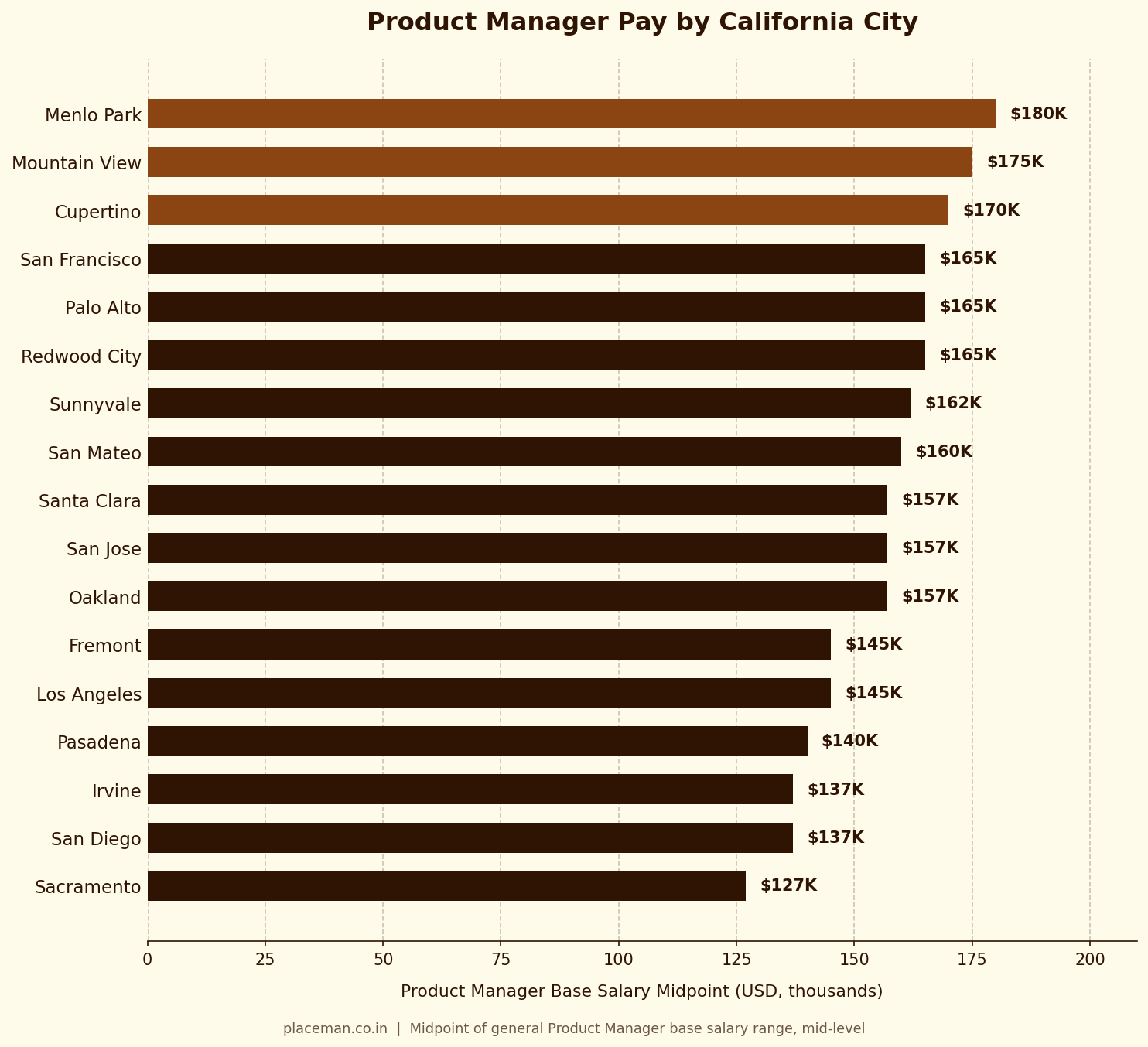
Before the city-by-city breakdown, here’s how mid-level Product Manager pay compares across California’s major metro areas:
San Francisco is widely regarded as one of the highest-paying cities in the United States for Product Managers, anchoring the broader Bay Area market covered in the city sections below (San Jose, Mountain View, Sunnyvale, Palo Alto, and others). The concentration of late-stage startups, Big Tech offices, and AI companies in San Francisco itself creates sustained upward pressure on comp. Across aggregated sources, median total compensation for a general “Product Manager” title in San Francisco lands somewhere in the $220K–$310K range, with base salary typically making up roughly $130K–$215K of that depending on level and company.
| Level | Base Salary Range |
|---|---|
| Associate PM | $100,000 – $140,000 |
| Product Manager | $135,000 – $195,000 |
| Senior PM | $175,000 – $245,000 |
| Lead / Staff PM | $210,000 – $270,000 |
| Principal PM | $235,000 – $300,000 |
| Group PM / GPM | $260,000 – $330,000 |
| Director of Product | $280,000 – $370,000 |
| Senior Director | $310,000 – $410,000 |
| VP of Product | $350,000 – $500,000 |
At large public companies (Google, Meta, and similar), total compensation including RSUs and bonus regularly exceeds base by 50–100%+, and senior/staff-level total comp at top-tier companies can reach $400K–$700K+. At the extreme end — late-career or executive levels at companies like Google — reported total compensation packages have exceeded $1M+ in individual cases, though these are outliers, not typical offers.
San Jose hosts Cisco, Adobe, eBay, and a large cluster of enterprise tech companies. Salaries trend slightly below core San Francisco but remain well above the national average.
| Level | Base Salary Range |
|---|---|
| Associate PM | $95,000 – $130,000 |
| Product Manager | $130,000 – $185,000 |
| Senior PM | $165,000 – $230,000 |
| Lead / Staff PM | $200,000 – $260,000 |
| Principal PM | $225,000 – $290,000 |
| Director of Product | $265,000 – $355,000 |
| VP of Product | $320,000 – $460,000 |
Oakland is increasingly searched separately from San Francisco as more companies and remote-hybrid PMs base themselves on the East Bay. Pay tracks close to San Francisco proper, slightly discounted.
| Level | Base Salary Range |
|---|---|
| Product Manager | $130,000 – $185,000 |
| Senior PM | $170,000 – $240,000 |
| Director of Product | $260,000 – $350,000 |
Mountain View is home to Google’s headquarters and hosts numerous mid-to-large tech companies. PM compensation here reflects Google’s aggressive benchmarking, and Google’s well-known Associate Product Manager (APM) program — based here — tends to skew entry-level pay slightly higher than in other cities.
| Level | Base Salary Range |
|---|---|
| Associate PM | $115,000 – $150,000 |
| Product Manager | $145,000 – $205,000 |
| Senior PM | $185,000 – $250,000 |
| Lead / Staff PM | $215,000 – $275,000 |
| Principal PM | $245,000 – $310,000 |
| Director of Product | $280,000 – $390,000 |
Sunnyvale hosts LinkedIn, Yahoo, and a dense cluster of networking and semiconductor companies. Technical PM roles here command a notable premium over generalist PM roles.
| Level | Base Salary Range |
|---|---|
| Product Manager | $135,000 – $190,000 |
| Senior PM | $175,000 – $240,000 |
| Principal PM | $230,000 – $300,000 |
| Director of Product | $270,000 – $370,000 |
Palo Alto concentrates early-to-mid stage startups alongside established firms like HP. Startup equity can make total comp highly variable here — base salary alone tells an incomplete story.
| Level | Base Salary Range |
|---|---|
| Product Manager | $135,000 – $195,000 |
| Senior PM | $175,000 – $245,000 |
| Director of Product | $260,000 – $365,000 |
Redwood City has a heavy concentration of mid-to-large SaaS and gaming companies, including Snowflake, Box, and Roblox. PM demand here is strong, particularly for Platform and Data PM roles.
| Level | Base Salary Range |
|---|---|
| Product Manager | $135,000 – $195,000 |
| Senior PM | $175,000 – $250,000 |
| Director of Product | $265,000 – $370,000 |
San Mateo is a dense SaaS hub (Roblox, Verkada, Coupa, and others). Compensation closely mirrors Redwood City and broader Peninsula norms.
| Level | Base Salary Range |
|---|---|
| Product Manager | $130,000 – $190,000 |
| Senior PM | $170,000 – $240,000 |
| Director of Product | $255,000 – $355,000 |
Santa Clara is a semiconductor hub — Intel, NVIDIA, and AMD all have major presence. Technical and Platform PM roles here are particularly well-compensated relative to generalist PM titles.
| Level | Base Salary Range |
|---|---|
| Product Manager | $130,000 – $185,000 |
| Senior PM | $170,000 – $235,000 |
| Principal PM | $225,000 – $290,000 |
| Director of Product | $265,000 – $355,000 |
Cupertino is Apple’s headquarters. Apple’s compensation structure differs from many tech companies, with a significant portion of total compensation often delivered through equity awards rather than cash base.
| Level | Base Salary Range |
|---|---|
| Product Manager | $140,000 – $200,000 |
| Senior PM | $180,000 – $245,000 |
| Principal PM | $235,000 – $300,000 |
| Director of Product | $280,000 – $390,000 |
Menlo Park is Meta’s primary campus. Meta is widely regarded as one of the highest-paying employers for Product Managers, and its presence raises the comp floor for the surrounding area.
| Level | Base Salary Range |
|---|---|
| Product Manager | $150,000 – $210,000 |
| Senior PM | $190,000 – $260,000 |
| Principal PM | $245,000 – $320,000 |
| Director of Product | $295,000 – $405,000 |
Fremont is home to Tesla’s Gigafactory and a growing hardware and EV tech cluster. Hardware PM and Technical PM roles here reflect specialized, in-demand skill sets.
| Level | Base Salary Range |
|---|---|
| Product Manager | $120,000 – $170,000 |
| Senior PM | $155,000 – $215,000 |
| Director of Product | $240,000 – $330,000 |
Los Angeles has grown rapidly as a tech hub, driven by entertainment tech, fintech, and consumer apps. Salaries trend below the Bay Area, though the cost-of-living gap between the two regions has narrowed in recent years.
| Level | Base Salary Range |
|---|---|
| Associate PM | $90,000 – $125,000 |
| Product Manager | $120,000 – $170,000 |
| Senior PM | $155,000 – $215,000 |
| Principal PM | $195,000 – $260,000 |
| Director of Product | $235,000 – $330,000 |
| VP of Product | $280,000 – $420,000 |
Pasadena is a growing Southern California tech node, with biotech, aerospace-adjacent tech, and enterprise software companies establishing a presence. Compensation tracks close to broader LA-area norms.
| Level | Base Salary Range |
|---|---|
| Product Manager | $115,000 – $165,000 |
| Senior PM | $150,000 – $210,000 |
| Director of Product | $220,000 – $310,000 |
Irvine is Orange County’s tech center, with a concentration of enterprise software, healthcare tech, and fintech companies.
| Level | Base Salary Range |
|---|---|
| Product Manager | $115,000 – $160,000 |
| Senior PM | $150,000 – $205,000 |
| Director of Product | $225,000 – $310,000 |
San Diego has a strong biotech, defense tech, and wireless technology sector, with Qualcomm as the dominant employer for Technical PM roles in the region.
| Level | Base Salary Range |
|---|---|
| Product Manager | $115,000 – $160,000 |
| Senior PM | $150,000 – $205,000 |
| Principal PM | $195,000 – $260,000 |
| Director of Product | $230,000 – $320,000 |
Sacramento has a smaller but meaningful tech and government-tech presence, with growing healthtech and civic-tech employers. Compensation is noticeably lower than the Bay Area or LA, but so is the cost of living.
| Level | Base Salary Range |
|---|---|
| Product Manager | $105,000 – $150,000 |
| Senior PM | $135,000 – $195,000 |
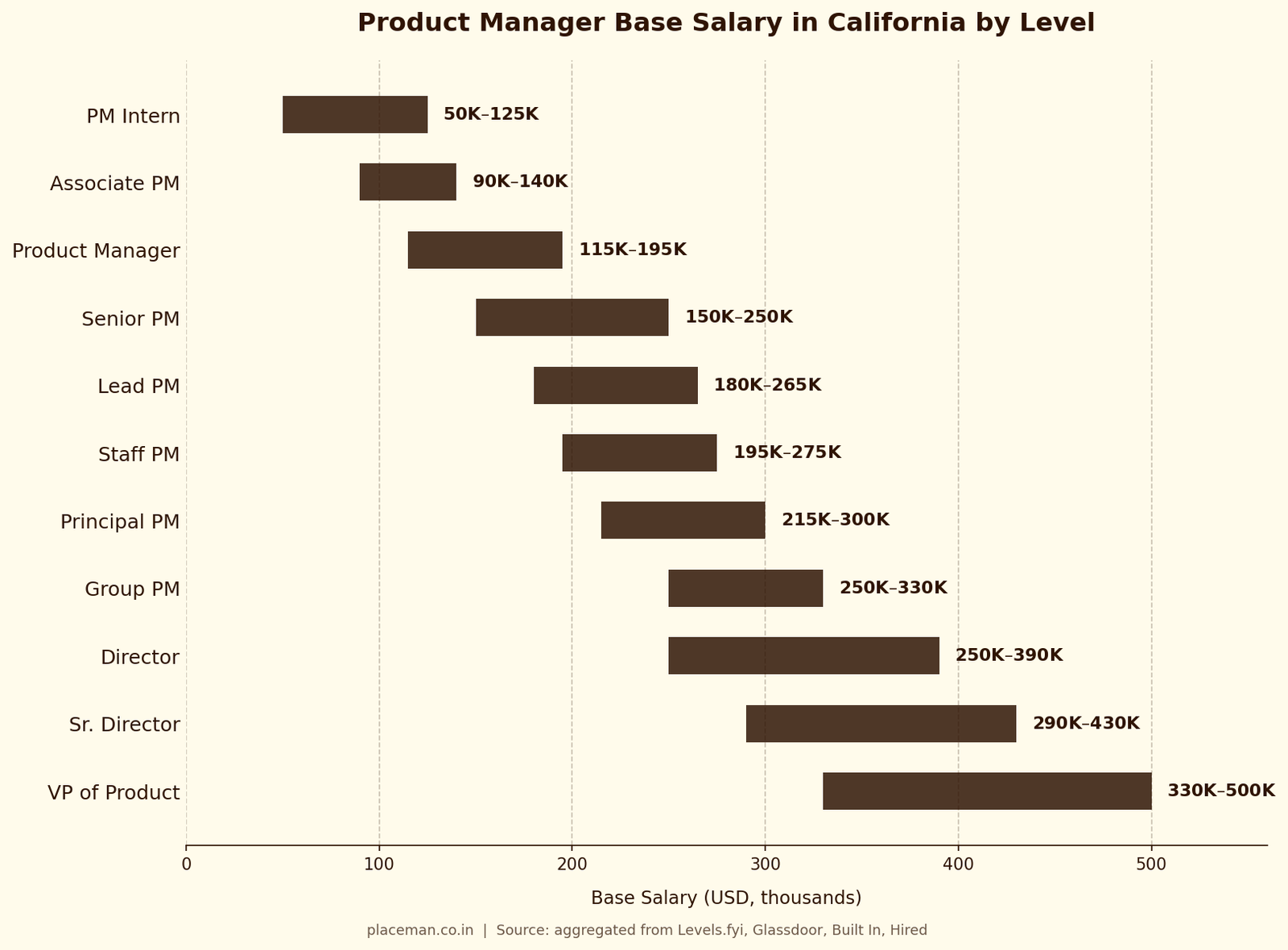
If you’re not targeting a specific city, here’s a statewide picture across the PM career ladder, expressed as base salary:
| Level | California Range (Base) |
|---|---|
| PM Intern | $25 – $60 / hour (roughly $50,000–$125,000 annualized) |
| Associate Product Manager | $90,000 – $140,000 |
| Product Manager | $115,000 – $195,000 |
| Senior Product Manager | $150,000 – $250,000 |
| Lead Product Manager | $180,000 – $265,000 |
| Staff Product Manager | $195,000 – $275,000 |
| Principal Product Manager | $215,000 – $300,000 |
| Group Product Manager | $250,000 – $330,000 |
| Director of Product Management | $250,000 – $390,000 |
| Senior Director of Product Management | $290,000 – $430,000 |
| VP of Product Management | $330,000 – $500,000 |
Compensation bands frequently overlap between adjacent levels — company size, funding stage, and equity grants often matter more than title alone. A Senior PM at a well-funded startup can out-earn a Director at a smaller or earlier-stage company once equity is factored in.
On total compensation at the top: the base ranges above are not the full picture for senior and executive roles. At large public companies and well-funded private companies, total compensation for Directors and VPs — once RSUs, bonus, and refresh grants are included — commonly lands well above base, and can exceed $700K–$1M+ in individual cases at the largest tech companies. Base salary alone significantly understates earning potential at these levels.
Specialization affects pay as much as seniority does — but absolute dollar ranges by specialty can be misleading, since they mix every level from Associate PM to Director into one band. A more useful way to think about this is the typical premium a specialty commands over a generalist PM at the same level and company:
| Specialty | Typical Premium vs. General PM |
|---|---|
| AI Product Manager | +10% to +25% |
| Platform Product Manager | +10% to +20% |
| Technical Product Manager | +5% to +20% |
| Data Product Manager | +5% to +15% |
| Growth Product Manager | 0% to +15% |
| Healthcare Product Manager | Variable — depends heavily on company and regulatory complexity |
To put this in context: a Senior PM earning $200,000 base in the general statewide range above might expect something closer to $220,000–$250,000 in an AI PM role at the same level and company, all else equal.
AI and Technical PM premiums have widened the most over the past two years, driven by demand outpacing the supply of PMs with credible technical or ML depth.
California’s SB 1162 requires employers with 15 or more employees to disclose a good-faith pay range in job postings. The law generally applies when employers are hiring for positions that may be performed in California, including remote roles.
For PM job seekers, this means:
This is one of the strongest pay transparency laws in the country, and it’s a meaningful advantage for candidates negotiating offers in this market.
| Level | California (Base) | US Average (Base) |
|---|---|---|
| Product Manager | $115,000 – $195,000 | $95,000 – $150,000 |
| Senior Product Manager | $150,000 – $250,000 | $125,000 – $190,000 |
| Director of Product | $250,000 – $390,000 | $190,000 – $290,000 |
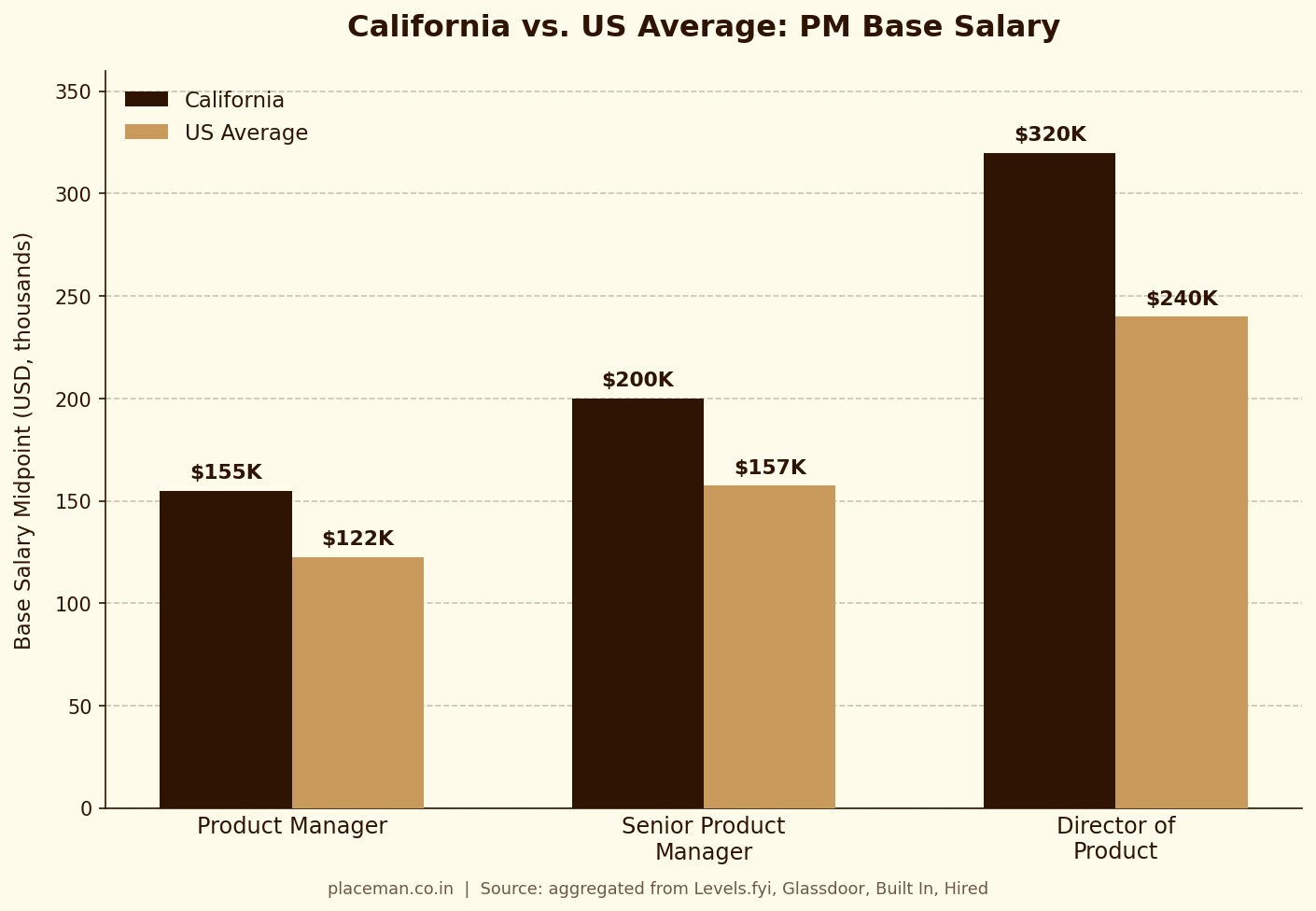
California PMs typically out-earn the national average by roughly 20–30% at the base salary level, with the gap widening further once equity is factored in — most large equity grants are concentrated at California-headquartered companies.
A $200K base salary in San Francisco does not go as far as a $200K base salary in San Diego or Sacramento. Bay Area cost-of-living indexes typically run 60–80% above the national average, driven overwhelmingly by housing. Many PMs in the Bay Area report spending 30–40% of base salary on rent or mortgage alone.
When comparing offers across California cities — or against out-of-state offers in markets like Seattle or Austin — it’s worth running the numbers through a cost-of-living calculator rather than comparing headline salary figures directly. State income taxes should also factor into the comparison: California has one of the highest state income tax rates in the country, which matters when weighing a California offer against opportunities in states with no state income tax, such as Texas, Washington, or Florida.
Company stage matters as much as title. A Senior PM at a Series A startup may carry a lower base than the same title at a public company, offset (in theory) by higher-risk, higher-upside equity.
Domain commands a premium. AI PM, Platform PM, and Technical PM roles consistently command a premium over generalist PM roles at the same level, as the relative premium table above shows.
Remote vs. onsite is converging, with caveats. Many California companies now hire remote PMs at or near Bay Area pay rates, though a growing number have introduced location-based salary adjustments for fully remote hires outside major metros.
These ranges reflect base salary unless stated otherwise. Total compensation — including equity, bonus, and benefits — can exceed base by 30–100%+ at public companies and high-growth startups, and the gap tends to widen at more senior levels.
When evaluating an offer, ask for the full TC breakdown: base, annual bonus target, equity grant size and current valuation, vesting schedule, and refresh grant policy. Under SB 1162, you’re also entitled to request the posted pay scale for the role if it wasn’t included in the listing.
What is the average Product Manager salary in California?
Statewide, base salary for a general Product Manager role typically falls between $115,000 and $195,000, with total compensation (including bonus and equity) often landing higher, especially at large public companies. The exact figure depends heavily on city, company, and level — see the city-by-city tables above for specifics.
What is the highest-paying city in California for Product Managers?
San Francisco and the surrounding Bay Area cities (Menlo Park, Mountain View, Cupertino) are widely regarded as the highest-paying region in California, driven by the concentration of Big Tech headquarters and well-funded startups.
How much does a Senior Product Manager make in California?
Senior Product Manager base salary statewide typically ranges from $150,000 to $250,000, with Bay Area cities at the top of that range and Southern California / Sacramento cities trending toward the lower end.
Do Product Managers in California receive equity?
Yes, equity (typically RSUs at public companies, or stock options at startups) is a standard part of PM compensation in California, especially at the Senior PM level and above. At large public companies, equity often makes up a substantial share of total compensation — frequently more than base salary at senior and executive levels.
Is California still the best state for Product Manager salaries?
California remains one of the top-paying states for PMs and the largest market by job volume, though states like Washington and New York are competitive in some studies, particularly at the total-compensation level. California’s edge is most pronounced when equity from California-headquartered tech companies is factored in.
Looking for Product Manager jobs in California? Browse current Product Manager, Senior Product Manager, Technical Product Manager, AI Product Manager, and Director of Product-level openings across California and the United States on Placeman.
Compensation figures in this guide are aggregated and rounded estimates based on publicly available data from Levels.fyi, Glassdoor, Built In, Hired, and California pay scale disclosures, current as of early 2026. Individual compensation varies significantly based on company, experience, negotiation, and market conditions. This guide is provided for informational purposes and should not be treated as a guarantee of any specific salary outcome.